
 /
/ 
Garmin takes another step into the world of sailboat racing
Garmin, a well-established manufacturer in the leisure fishing sector, is now seeking to extend its reputation in the pleasure boating sector, mainly sailing regattas. The equipment manufacturer has already become a partner of the Spi Ouest France in 2025, a major event in the French sailing calendar. This race, which takes place over the Easter weekend, brings together over 400 yachts and is a showcase for onboard electronic equipment.
In addition to this partnership, Garmin aims to demonstrate the adaptability of its products to regatta configurations, by equipping a production sailboat: a Bénéteau First 34.7, an emblematic amateur regatta boat.

A production sailboat as a full-scale test bed
The First 34.7 selected for this refit is a realistic support: neither a prototype, nor an ocean-racing boat, but an accessible cruiser-racer, widely available on the second-hand market. This choice underscores a strategic objective: to prove the compatibility of Garmin instruments with regattas on houseboats, without resorting to extreme racing models, on which Garmin has already been working alongside Jérémy Bayou on the IMOCA Charal for 5 years.


Electronics designed for crew performance
The new configuration is based on a complete NMEA 2000 network. At the chart table, a GPSMAP 1223 (12" multifunction plotter) centralizes navigation data. It communicates with a GND10 wind vane-anemometer and a DST810 probe (depth, speed, temperature).

For a?chage during navigation, three GNX120s installed at the mast foot provide optimum visibility, even from sidewalks. Each display can show three data simultaneously. The GNX remote control in the cockpit allows you to modify the a?chage according to the regatta phases in progress.
Optimized cockpit for helmsman and crew
The helm station houses two TD50 displays on either side of the wheel. These mini-multifunction a?chent key data in the immediate vicinity of the helmsman. A third TD50, mounted on the cockpit wall, is oriented towards the crew during maneuvers.
Safety has not been neglected: the black-box VHF315i is coupled with a handset and speaker in the cockpit, and an AIS module. This system enables the crew to follow departure procedures without interference, and to maintain an e?cient watch while navigating.

An accessible technical facility for enlightened amateurs
This equipment is based on NMEA 2000 architecture, reducing the need for redundant cabling. The GNX120s were installed at the mast foot without any additional drilling, using existing brackets. The TD50s at the helm station simply required drilling into the side walls.
The entire system is connected to the Reactor autopilot, equipped with a special Garmin kit for improved steering under sail. Finally, the Fusion RA670 audio system completes the on-board comfort, with speakers in the cabin and cockpit.

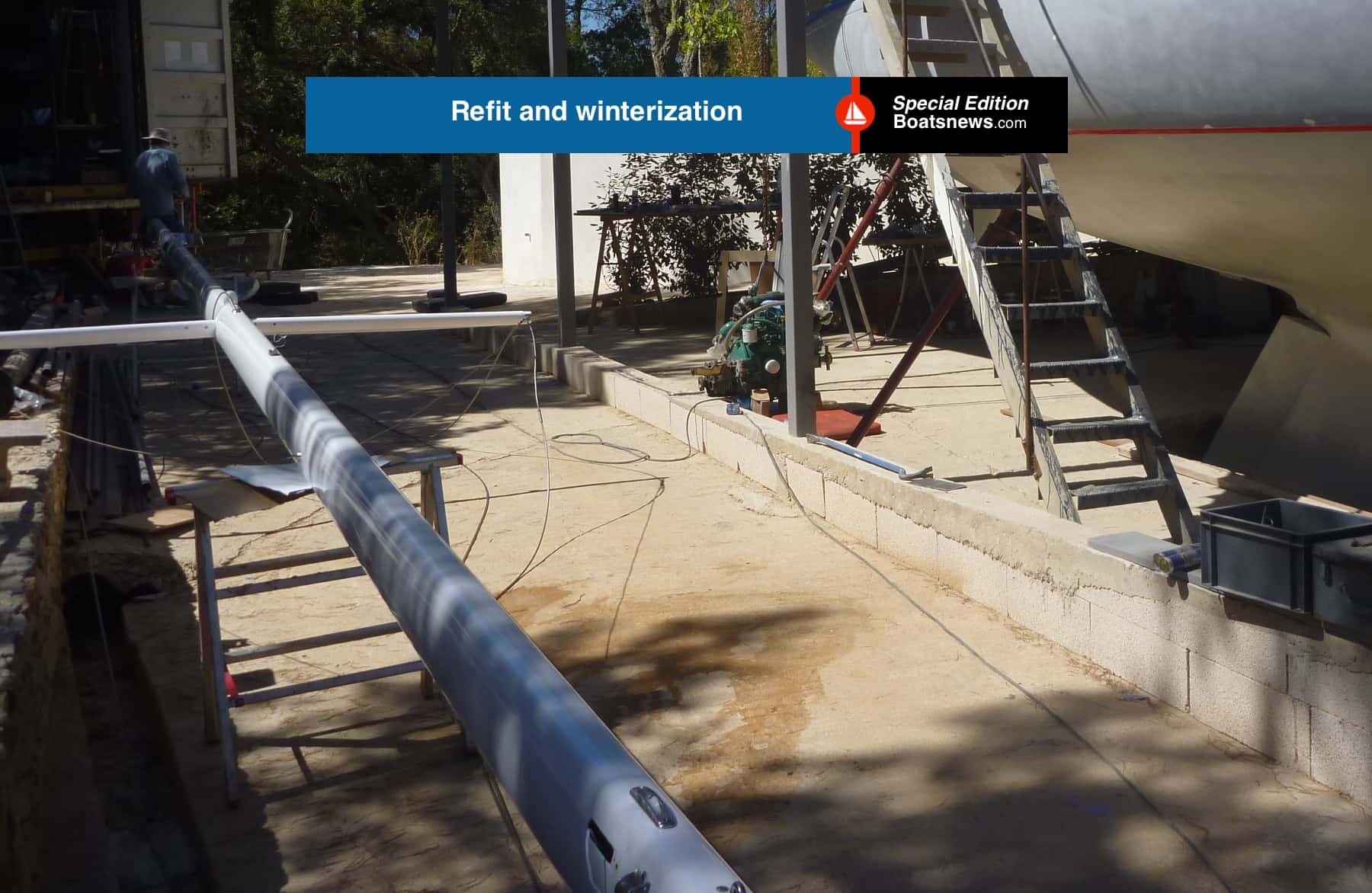
The refit was carried out in six days by a single person, including removal of the old electronics.
The comprehensive equipment on this First 34.7 illustrates Garminâ??s determination to penetrate the world of live-aboard regattas. The Spi Ouest France experience could be the start of a wider diffusion of Garmin instruments to amateur regatta sailors.


